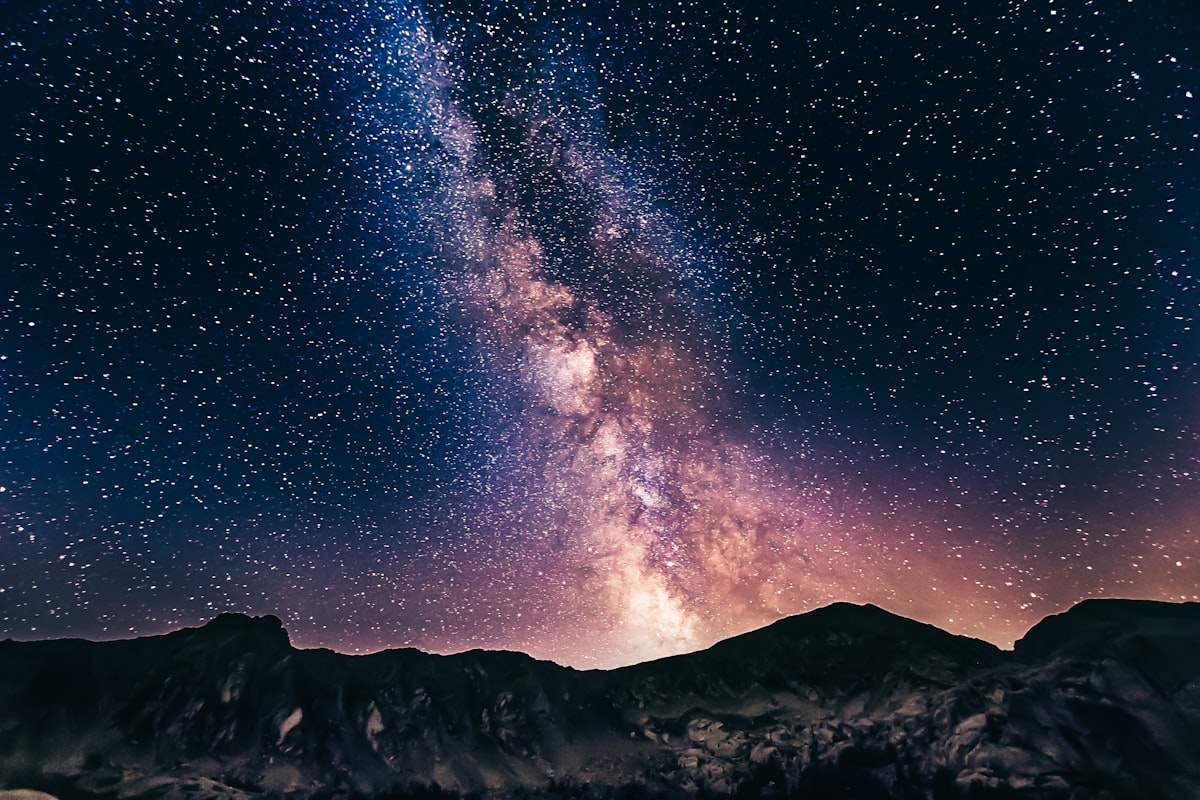
If the moon in Japan is for solitary longing, the stars are for reunion — because the single biggest thing the stars mean in Japanese culture is a love story told once a year, on the seventh night of the seventh month, across the river of heaven. Let’s take the story first, then the names, because the names don’t make full sense without it.
The kanji: 星
The character is 星 (hoshi, or sei in compounds). On its own it’s “star”; in pairs it builds whole skies — 明星 (myōjō), the bright star, which is what Japanese calls the planet Venus when it hangs at dawn or dusk; 北斗 (Hokuto), the Big Dipper; 流星 (ryūsei), a shooting star, literally a “flowing star.” It is a clean, bright, optimistic character, and — unlike the moon — it is used freely in names for boys and girls. Hold onto that difference; we’ll come back to it.
Tanabata: the two stars who meet once a year
Look up on a clear summer night and you’ll find two bright stars on opposite banks of the Milky Way — the 天の川 (Amanogawa), the “river of heaven.” One is Vega; one is Altair. In Japan they are a weaver and a cowherd, and they are in love.
The story, 七夕 (Tanabata, the “Star Festival”), came from China and has been kept in Japan since the eighth century. 織姫 (Orihime, the “Weaver Princess,” the star Vega) wove beautiful cloth for her father, the lord of the sky — until she met 彦星 (Hikoboshi, the “Cowherd Star,” Altair), fell in love, and married him. So happy together, the two of them stopped working: her loom went silent, his cattle wandered. Her father, furious, split them apart, one on each side of the Amanogawa, and forbade them to meet.
But Orihime wept so bitterly that he relented — a little. Once a year, on the seventh night of the seventh month, the two are allowed to cross the river of heaven and spend a single night together. In the gentlest version of the tale, a flock of magpies forms a bridge across the Milky Way so she can reach him. If it rains, the river floods and they must wait another year.
This is why, every July, you’ll see bamboo branches outside houses and stations hung with 短冊 (tanzaku) — narrow strips of colored paper, each carrying a wish in handwriting. (Children once wished, charmingly, for two specific skills: girls for better sewing, like Orihime; boys for better handwriting.) The whole country, briefly, makes a wish on a pair of stars. After the festival the bamboo is often floated down a river or burned — the wishes sent off toward the sky.
So when 星 turns up in a Japanese name, this is the air around it: not loneliness, but distance bridged; not waning, but a light that keeps faith across an impossible gap.
The names
Because the star is bright and hopeful and not tied to any one gender, parents use 星 generously — there are well over a thousand registered girls’ names with it and several hundred for boys. A sampling, with kanji and readings:
流星 — Ryūsei. “Shooting star,” a “flowing star.” A popular, energetic boy’s name — motion and light in two characters. (If it sounds familiar from manga and idol culture, that’s no accident; it’s exactly the kind of name that reads as cool and a little cosmic.)
光星 — Kōsei. “Light-star.” A boy’s name that doubles the brightness — 光 (light) and 星 (star) reinforcing each other.
星奈 — Sena. A soft, modern girl’s name pairing 星 with 奈, a gentle phonetic character common in women’s names.
星良 — Seira. “Star” plus 良 (good, fine) — and the sound lands close to the Western “Sera/Sara,” which makes it a graceful bridge name.
明星 — Myōjō. The morning/evening star — Venus. More often a word than a given name, but it tells you how the language thinks: the brightest “star” in the sky gets a name meaning “bright star,” and it’s actually a planet.
北斗 — Hokuto. The Big Dipper, the seven stars of the Plough — a strong, classic boy’s name. Anyone who knows Fist of the North Star (北斗の拳, Hokuto no Ken) has met it; the title points straight at this constellation.
That gender balance is the quiet lesson here. Moon names lean feminine and wistful; star names are open to everyone and lean hopeful. Same night sky, two completely different moods, and Japanese parents read the difference instinctively.
And your name?
A name like Owen or Stella doesn’t translate into 星 — but you can still reach for the star. Stella and Esther already mean star in their own roots, which is a lovely thing to know; and for any name, you can choose meaning kanji that carry the idea of starlight, or simply set your name in katakana and let it shine beside the meaning. That’s what our name tool is built to show you — run your name and you’ll see the phonetic katakana alongside kanji chosen for meaning and for play, stars included. For how the three scripts fit together, start with the three ways to write your name in Japanese.
Part of our series on Japanese names by meaning — names that mean moon is its natural companion, the other half of the night sky, alongside fire, love, light, dark, water, and flower.