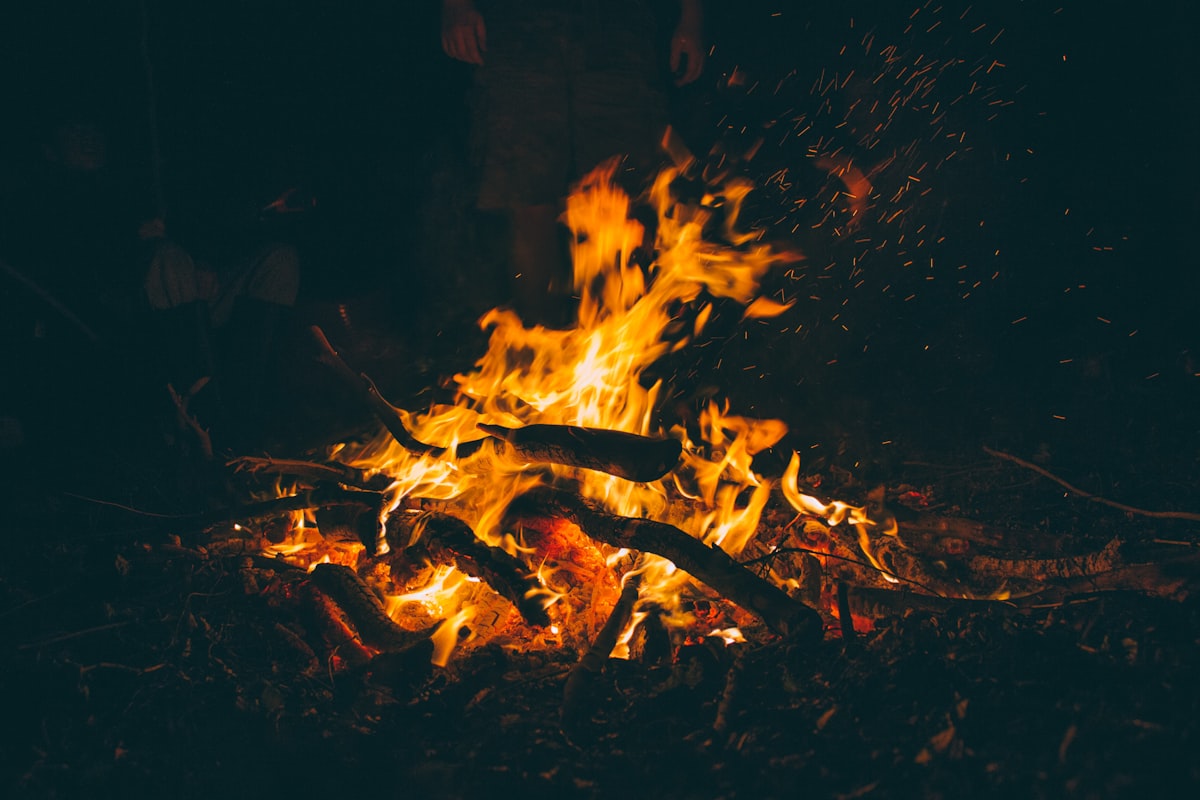
This entry in the series is different, because the honest answer to “what Japanese names mean fire?” is: surprisingly few. After moon and star, you might expect fire — the most dramatic element of all — to blaze across the naming charts. It doesn’t. And the reason it doesn’t is the most interesting thing about it.
The kanji: 火
The character is 火 (hi, or ka in compounds), and it’s a pictograph of a flame, two sparks flying off a central blaze. It builds the obvious words — 火山 (kazan, “fire-mountain,” a volcano), 花火 (hanabi, “fire-flowers,” fireworks) — and it names Tuesday, 火曜日, the “fire day,” after the planet Mars. It is everywhere in the language. It is almost nowhere in given names. To understand that gap, you have to start with how fire arrives in the oldest Japanese story.
The myth: fire brings the first death
In the Kojiki, the mother of the world, the goddess Izanami, gives birth to the elements one after another — until she bears 火之迦具土 (Hi-no-Kagutsuchi), the kami of fire. His birth is the catastrophe: the flames of him burn his mother so badly that she sickens and dies. Fire, in the founding myth, is the thing that brings death itself into a world that until then had none.
Her husband Izanagi, wild with grief, draws his sword and beheads the newborn fire god — and here the myth turns, because from Kagutsuchi’s blood and severed body spill more gods: deities of mountains, of water, of thunder and the sword, and his eight chopped pieces become eight volcanoes. Fire kills the mother of creation, and out of its own destruction creates again.
That double face — fire as the bringer of death and the source of new life — is exactly how Japan has always treated the real thing. Fire is revered and feared and, above all, managed: kept in the hearth, walled off, watched. A culture that built its cities of wood and paper learned in its bones that fire is not a thing you invite in casually. Not even into a name.
Why 火 stays out of names
To be clear, there is no law against it — 火 is a perfectly usable character. But parents avoid it, for a tangle of soft reasons that say a lot about the culture:
- Bad-luck association. Fire shades easily toward 災 (wazawai, “disaster, calamity”). In old rural Japan, where child mortality was high, parents grew superstitious about anything that hinted at harm, and “fire” hinted too loudly.
- Five-element fortune-telling. In naming by gogyō (五行, the five elements), a diviner may specifically tell a family to avoid a fire-element character to keep a child’s chart in balance.
- The sheer intensity of it. Even setting superstition aside, 火 simply reads as too hot — a blaze rather than a warmth. It’s a hard image to wish onto a soft new baby.
So the fire stays in the hearth — which is the one place Japanese is completely comfortable with it. The traditional cooking stove, the 竈 (kamado), is the safe, domestic, life-giving form of fire: the fire that feeds the family. (Readers of our Demon Slayer piece will recognize it — the hero’s surname, Kamado, is that hearth, and his family burns charcoal for a living. Fire is fine in a name when it’s the hearth, not the inferno.) And once a year at Obon, fire becomes a doorway: families light okuribi, send-off fires, to guide the spirits of the dead back out of this world. Fire as threshold, again — the same myth, still running.
What Japanese reaches for instead
Here’s the elegant part. Parents who want the feeling of fire — warmth, brightness, energy — don’t use 火. They reach one step sideways, for light and sun:
- 陽 (yō / haru / hi) — sunlight, the sunny side. One of the most popular naming characters in Japan right now: 陽葵 (Himari), 陽太 (Yōta), 陽菜 (Hina). It gives all the warmth of fire with none of the danger.
- 灯 / 燈 (akari, tomo) — lamplight, a small flame deliberately tamed. 灯 (Akari) is a gentle, lovely girl’s name: light you can hold.
- 煌 (kira, kō) — a glittering, sparkling brightness; 照 (teru) — to shine, to illuminate.
The pattern is its own small philosophy: Japanese will happily name a child for the light of fire, but not for the burning. The warmth, yes; the flame, no.
And your name?
If your name carries fire — Aiden (a little fiery one), Ignatius, Brenda (from a root for sword/flame), Seraphina (the “burning ones”) — that’s a real and old meaning, and worth knowing. But notice that if you ask Japanese to give it to you in kanji, the language will gently steer you toward warmth and light rather than the blaze itself — toward 陽 and 灯 rather than 火. That’s exactly the kind of choice our name tool surfaces: run your name and you’ll see the katakana plus meaning-kanji and ateji options, and you can decide how much heat you actually want in it. For the full picture, see the three ways to write your name in Japanese.
It’s a fitting lesson from the element that, in the oldest story Japan has, was both the first death and the maker of mountains: handle with care — even in a name.
Part of our series on Japanese names by meaning — see also moon, star, love, light, dark, water, and flower.