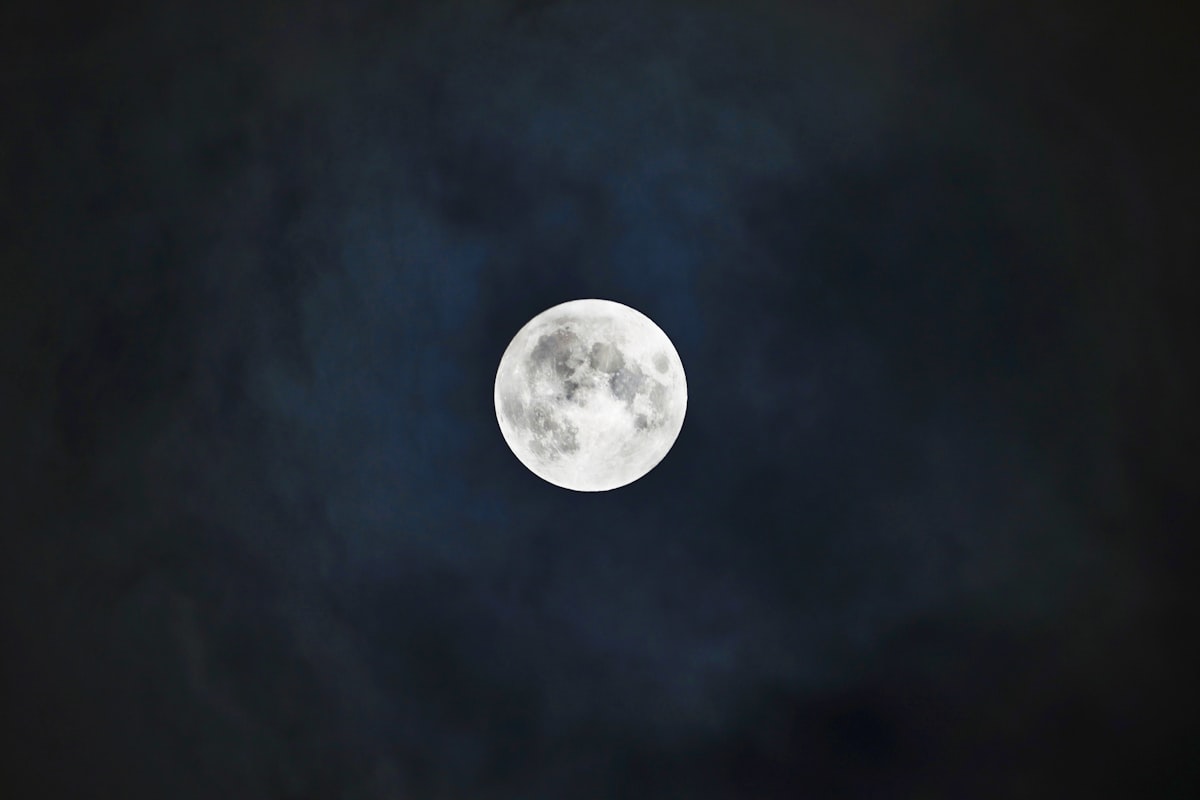
Before we get to the names, a confession about why there are so many of them: in Japan, the moon was never just a light in the sky. It was the calendar, the festival, the poem, the god you didn’t talk about much, and a princess who had to go home. If you want a name that means “moon,” you are reaching into one of the deepest wells in the language. So let’s start with the well, and then draw the names out of it.
The kanji: 月
The character is 月 (tsuki), and the first thing to know about it is that it does double duty. 月 means moon — but it is also the character for month. January is 一月 (ichigatsu), literally “first moon”; the months march on as 二月, 三月, “second moon, third moon,” all the way to 十二月. This isn’t a coincidence or a pun. For most of Japanese history the calendar was lunisolar — the months were counted by the moon, each one beginning at the new moon and swelling to full and back. A “month” was a moon. The word still carries that, every time someone writes the date.
You can hear the same idea in the name of the moon god, 月読 (Tsukuyomi) — 月 “moon” plus 読 “to read, to count.” The deity of the moon is, in his own name, the one who reads the months: the keeper of time. We’ll come back to him.
In names, 月 is usually read tsuki (or zuki when it follows another sound), and occasionally getsu. It is one of the most beautiful single characters you can put in a name, and Japanese parents have known it for centuries.
Why the moon, and not the sun?
Japan has a famous sun — the goddess Amaterasu (天照), ancestor of the imperial line, is literally “she who shines in heaven,” and the country’s own flag is a red sun on white. You’d expect the sun to win. And in mythology it does.
But in feeling — in poetry, in aesthetics, in the things people actually loved — the moon quietly took over. Open the Man’yōshū, Japan’s oldest poetry anthology, or The Tale of Genji, and the moon is everywhere: a thin presence to sigh at, a light to compose by, the proper companion for longing and for autumn. The Japanese aesthetic prized the partial, the passing, the understated — and the moon, which changes shape every night and is gone by morning, fit that taste far better than the blunt, unchanging sun. The cherry blossom gets loved because it falls. The moon gets loved because it wanes.
There’s even a mythological reason the two were split apart. The moon god Tsukuyomi was born — depending on which chronicle you read — from the right eye of the creator god Izanagi, alongside his sister Amaterasu (the sun) and their brother Susanoo (the storms): the three noble children. But Tsukuyomi, sent to dine with the food goddess Ukemochi, was so disgusted to watch her produce a feast by spitting fish from her mouth that he killed her. Amaterasu was so appalled by her brother’s rudeness that she refused to ever share the sky with him again. And that, the old story says, is why the sun and the moon are never out together: a falling-out between siblings. Tsukuyomi himself barely appears again — he is the quiet one of the three, which is somehow the most fitting possible biography for a moon.
The night everyone looked up: 月見
If the moon had a single holiday, it is 月見 (tsukimi), “moon-viewing.” The big one falls on 十五夜 (jūgoya), the fifteenth night of the eighth lunar month — the harvest moon of mid-autumn, usually September or October. It began, like a lot of refined Japanese pastimes, with Heian-era aristocrats borrowing from China: they would gather on verandas and boats, drink, and compose poetry under the full moon. The truly elegant move was not to gaze at the moon directly but at its reflection — in a pond, in a cup of sake — because looking at the thing itself was a little vulgar.
The customs that survive are humbler and lovely. You set out 月見団子 (tsukimi dango), little white rice dumplings stacked in a pyramid, pale and round like small moons. You stand up a vase of すすき (susuki, pampas grass), whose silver plumes stand in for rice stalks, and you give thanks for the harvest — sweet potatoes, chestnuts, beans. It is a quiet, grateful holiday, and it is still observed — and not only in the elegant way. The tradition is so alive that every autumn the fast-food chains roll out tsukimi menus: McDonald’s Japan has sold a 月見バーガー (Tsukimi Burger) since 1991, and the whole conceit is that the round fried egg on top is the full moon. A thousand years from Heian poets watching the moon’s reflection in a sake cup to a fried egg on a burger called “moon-viewing” — and somehow it’s the same idea, wobbling but intact. That is how deep this one image runs.
And here is the tangent worth taking: when a Japanese person looks at the full moon, they do not see a man in it. They see a rabbit, and the rabbit is pounding mochi — hammering glutinous rice into cakes with a mallet, the same way mochi is actually made. The dark patches Westerners assembled into a face, Japan assembled into a rabbit at work. Once you’ve been told, you can’t unsee it: there’s the mallet, there’s the bowl. This single image — moon, rabbit, mochi — will matter a great deal when we get to a certain magical-girl heroine.
The oldest story Japan has is about the moon
Now the deep root. The oldest surviving narrative in Japanese literature — the monogatari that every later story descends from, written in the late ninth or early tenth century — is the 竹取物語 (Taketori Monogatari), the Tale of the Bamboo Cutter. And it is, at its heart, a story about the moon.
An old bamboo cutter finds a baby girl glowing inside a stalk of bamboo. He and his wife raise her; she grows in three months into a woman of impossible beauty, and they name her かぐや姫 (Kaguya-hime) — the radiant princess, the hime whose name is written with 輝 (“to shine, to gleam”) and 夜 (“night”): the shining one of the night. Emperors and nobles beg to marry her; she turns them all away with impossible tasks.
Then the truth comes out. Kaguya is not of this world. She is from 月の都 — the Capital of the Moon — sent down to Earth as a kind of exile, a punishment whose sentence is precisely that she will form attachments to this place and these people, and then be forced to leave them. When the celestial procession descends to take her back, she weeps; she does not want to go. But they drape her in a feather robe, the hagoromo, and the moment it touches her shoulders her earthly memories and sorrows fall away. She returns to the moon serene, having forgotten the parents now weeping on the ground below.
It is over a thousand years old and it still aches. The moon, in the oldest story the country has, is the place you come from and must return to — beautiful, distant, and a little heartless. That ending is sitting under every moon-name a parent has chosen since.
The names
So when Japanese parents reach for 月, they are reaching for all of that — the calendar, the harvest moon, the rabbit, Kaguya going home. Here are real names that carry it, with their kanji and readings.
美月 — Mizuki (also read Mitsuki). “Beautiful moon.” One of the most popular girls’ names in modern Japan, and a near-perfect one: the 美 (beauty) and the 月 (moon) need no explanation, and the sound is soft on every syllable.
月子 — Tsukiko. “Moon child,” straight and unadorned — 月 plus 子, the classic, slightly old-fashioned -ko ending that has closed Japanese girls’ names for generations.
葉月 — Hazuki. “Leaf moon.” And here the moon-as-month returns: 葉月 was the old calendar’s name for August, the month the leaves begin to turn. Give a daughter this name and you’ve given her both a moon and a season.
望月 — Mochizuki. “The full moon” — 望 here means the moon at its fullest. It’s most common as a surname (you’ll meet Mochizukis all over Japan), which is worth knowing: the moon lives in family names too, not only given ones.
輝夜 — Kaguya. Yes — you can name a child after the moon princess herself, the radiant one of the night. It’s a bold, literary choice, and everyone who hears it knows the story.
ルナ — Runa (Luna). The modern, outward-looking option: the Latin word for moon, written in katakana because it came from outside. It’s increasingly chosen by Japanese parents who want the moon without the kanji — and it’s a useful bridge for a foreign name, which we’ll get to.
A note worth making honestly: moon names in Japan lean strongly feminine and poetic. There are far more Mizukis than there are boys named for the moon. If you want the moon in a more gender-neutral form, the surnames — Mochizuki (望月), Ōtsuki (大月), Gassan (月山, “moon mountain”) — are the place it sits without leaning either way.
One more, because it’s perfect: 月野うさぎ
If you grew up anywhere on Earth in the last thirty years, you already know a moon name and may not have noticed. Sailor Moon’s real name is 月野うさぎ — Tsukino Usagi. Break it open: 月 (moon) + 野 (field) makes the surname Tsukino, “moon field,” and うさぎ (Usagi) means rabbit.
Now remember the rabbit pounding mochi on the moon. Naoko Takeuchi built that whole folktale into a single name. Said in Japanese order, Tsukino Usagi can be heard as 月のうさぎ — tsuki no usagi, “the rabbit of the moon” — the exact creature everyone sees in the full moon, attached to a heroine who turns out to be a princess of the Moon Kingdom. It is one of the cleanest name-jokes in anime, hiding in plain sight in a show watched by millions who never caught it. (We pull apart more of these in our piece on anime girl names.)
And your name?
Here’s the catch for the rest of us: a name like Emma or Liam doesn’t mean moon at the root, the way Mizuki does. You can’t translate your way into 月. But you have two honest routes.
You can take the katakana road that Runa takes — render your name phonetically and let it sit beside its meaning, the way foreign names do in Japan. Or you can choose meaning kanji or ateji — characters picked to carry an idea you want, including the moon, layered under the sound of your name. That second route is exactly what our name tool is for: run your name through it and it’ll show you the katakana, plus kanji chosen for meaning and for play — and if the moon is what you’re after, you’ll know which characters to ask for. For the full picture of how the three scripts work together, start with the three ways to write your name in Japanese or how Japanese names actually work.
Part of our series on Japanese names by meaning — see also names that mean star (the other half of the night sky), fire, love, light, dark, water, and flower.
The moon has been the quiet center of this language for a thousand years — the month, the festival, the rabbit, the princess. There are worse things to carry in a name.