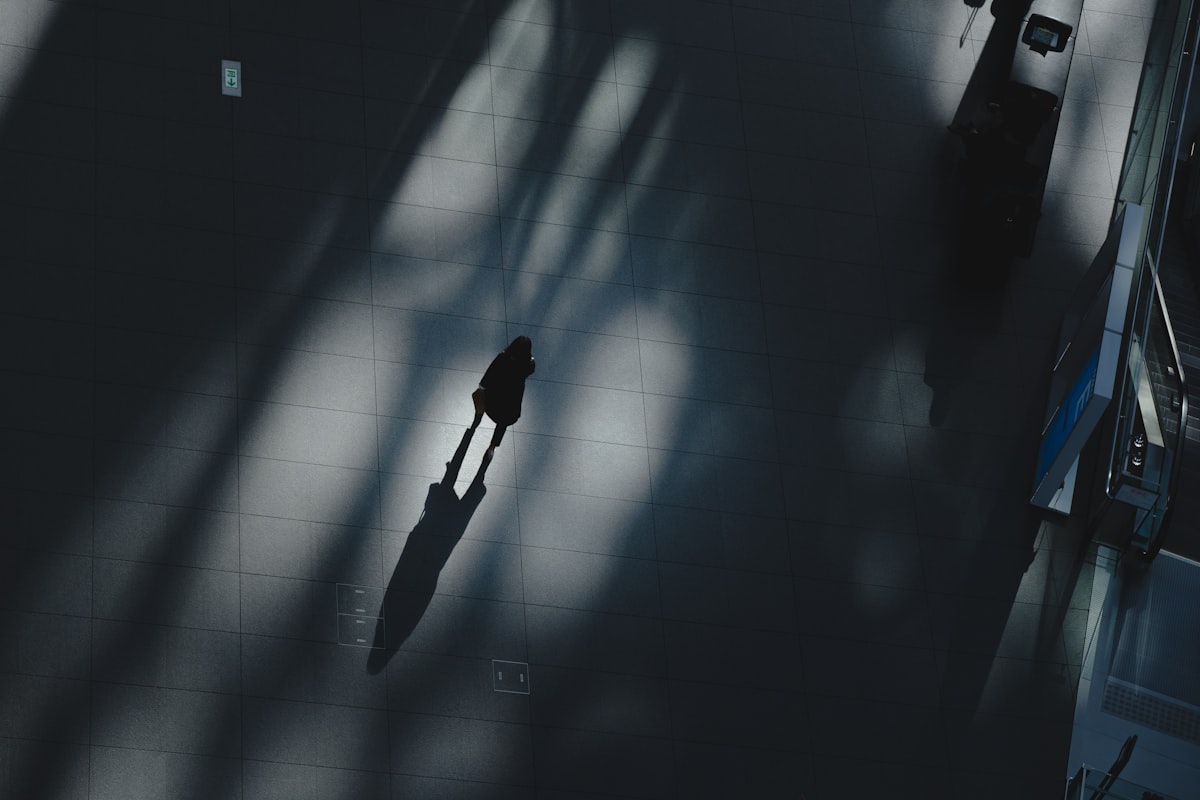
This is the request that comes loaded with a Western assumption, so let’s clear it first. People searching for a “dark” Japanese name are usually after something gothic, edgy, a little dangerous. Japanese darkness isn’t quite that — and where the West hears dark = evil, Japan has spent a thousand years hearing dark = depth, atmosphere, beauty. That difference changes everything about how — and whether — darkness shows up in a name.
The kanji: 闇 and 影
闇 (yami) is darkness — the absence of light, the dark you can’t see through. 影 (kage) is shadow — the shape cast by a thing standing in light. They’re related but not the same: yami is a condition, kage is a presence. (A kagemusha, 影武者, is a “shadow warrior,” a body-double who stands in for a warlord — the shadow of a man.)
Here’s the first honest note: 闇 only became legal for use in given names in September 2004. For most of modern Japanese history you literally could not register a child as 闇, and even now almost no parent does. The same goes, softly, for 影. If you go looking, you’ll find these characters all over fiction, manga, and the realm Japanese affectionately calls chūnibyō — the dramatic, edgy naming of invented characters — and almost nowhere on actual children. So the truthful headline is: real Japanese dark-names barely exist, and pretending otherwise would be inventing them.
The time a father tried to name his son “Devil”
How firmly does Japan draw this line? Firmly enough to go to court. In 1993, a father in Akishima, near Tokyo, registered his newborn son as 悪魔 — Akuma, “devil.” The ward office, noting that both characters were on the approved list, stamped it at the counter — then thought better of it, consulted the Ministry of Justice, and tried to take the name back. The father fought it, and the whole country argued about it for months.
The Tokyo Family Court’s 1994 ruling threaded a fine needle: the kanji were perfectly legal, the judges agreed — but naming a child “Devil” was an abuse of the right to name (命名権の濫用), because the name itself would harm the child forced to carry it. It became a landmark — the first time a Japanese court weighed a parent’s freedom to name against a child’s welfare, and came down on the side of the child. (It’s still invoked today in debates over flashy kira-kira names and the naming rules tightened in 2025.)
The ending is the most telling part. Having made his point, the father eventually backed down and registered the boy under a different name — 亜駆, also read Aku. He kept the sound he wanted and swapped in harmless kanji (亜, “sub-, Asia”; 駆, “to gallop”) carrying no menace at all. Which is, if you squint, exactly the ateji move — sound preserved, meaning quietly rewritten. Even the man who set out to name his son Devil ended up solving it the way Japanese has always handled foreign and awkward names: pick the kanji for how they sound, and let the meaning behave.
But darkness is not the enemy here
The reason isn’t that darkness is evil. It’s that, in Japan, darkness is aesthetic — an atmosphere to be savored, not a label to hang on a person.
The classic text is Junichiro Tanizaki’s 1933 essay 陰翳礼讃 (In’ei Raisan), usually translated In Praise of Shadows. Tanizaki argues that Japanese beauty lives in dimness, not brightness: lacquerware was made to glow softly by candlelight, not blaze under electric bulbs; gold leaf was used precisely because it catches the little light in a shadowed room; the most beautiful spaces are the dim ones, where things are half-seen. Where the West chases ever more illumination as “progress,” he says, the Japanese tradition found its beauty in the shadows — the restraint, the suggestion, the not-quite-seen. It’s one of the most influential essays ever written on Japanese aesthetics, and it’s the real answer to “what does dark mean in Japan?”: not menace, but depth.
What Japanese reaches for instead
When darkness does enter a name or a literary mood, it tends to come in softer, deeper-toned characters than the blunt 闇:
- 夜 (yoru, ya) — “night.” Far gentler than “darkness,” and it carries the moon and stars with it. It appears in names like 夜空 (Yozora, “night sky”), and in 輝夜 (Kaguya) — yes, the moon princess, “the shining one of the night.”
- 玄 (gen) — a profound, mysterious dark; the black with depth in it, as in 玄人 (kurōto, an expert — someone with hidden depths). It’s the dignified way to say dark.
- 墨 (sumi) — ink-black, the black of calligraphy and brushwork. A made thing, a beautiful black.
The pattern echoes what we found with fire: the raw, intense version of the element (闇, 火) stays out of names, and Japanese reaches one step sideways — to night, to ink, to depth — for the part of it that’s beautiful rather than dangerous.
And your name?
If you’re drawn to a dark name, the most authentic route in Japanese isn’t 闇 at all — it’s the night (夜), the profound (玄), the inked black (墨), or the shadow (影) used with care. Set your own name in the tool and you can see which meaning-kanji it suggests, then steer toward the shadowed end deliberately, the way Tanizaki would have wanted — depth, not melodrama. For how the scripts work together, start with the three ways to write your name in Japanese.
Part of our series on Japanese names by meaning — its natural opposite is names that mean light; see also moon and star.