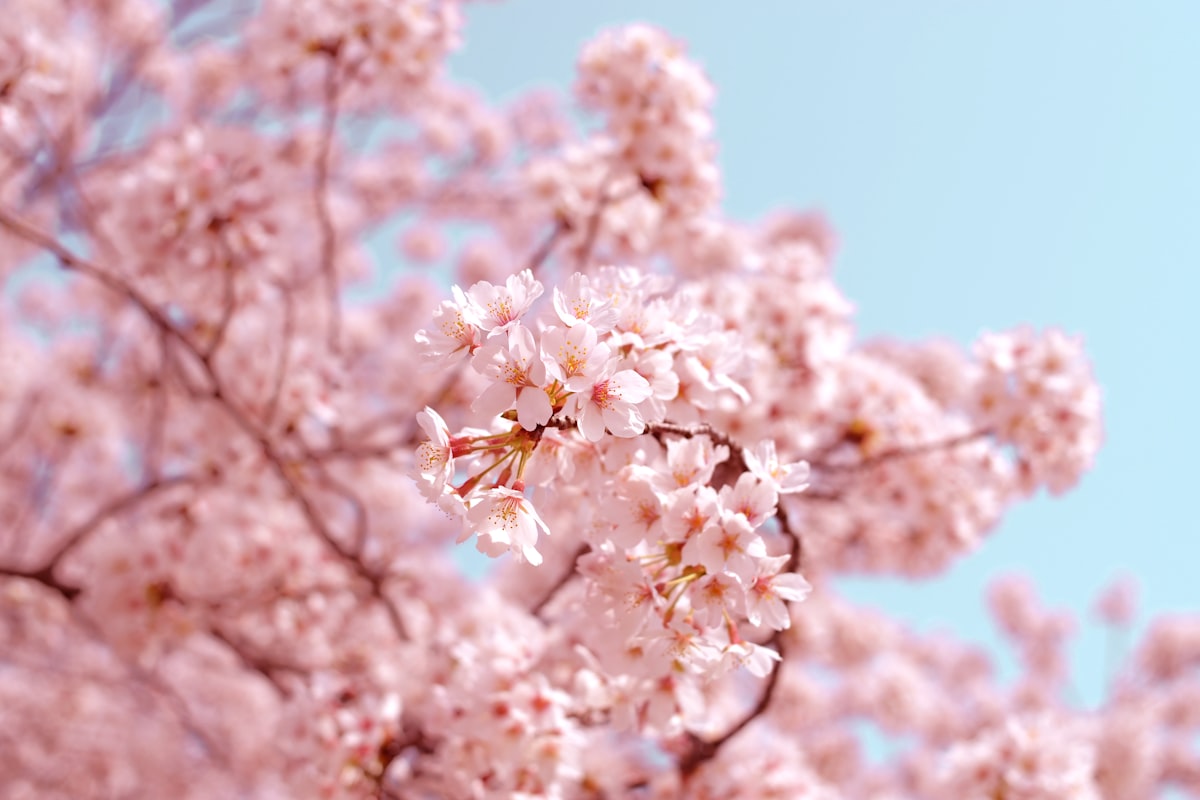
Of all the meanings in this series, the flower is the one Japanese parents reach for most. 花 (hana) is, as of recent counts, the second most popular naming character for girls in Japan. To understand why a single flower carries that much weight, you have to understand that in Japan a flower is never just pretty — it’s beautiful because it doesn’t last.
The kanji: 花
花 (hana, or ka in compounds) is “flower,” “blossom.” It builds 花火 (hanabi, fireworks, “fire-flowers”), 花見 (hanami, flower-viewing), 生花 / 華道 (ikebana / kadō, the art of arranging flowers). A close cousin, 華 (also hana or ka), means flower in a grander, more ornate sense — splendor, magnificence — and is also used in names.
Beauty because it falls
The Japanese love of flowers crystallizes around one event: 花見 (hanami), cherry-blossom viewing. The earliest recorded flower banquet was held by Emperor Saga in 812, and within a century or two the whole aristocracy was composing poetry under the blossoms. But the feeling underneath hanami is the key, and it has a name: もののあはれ (mono no aware) — roughly, “the gentle sorrow of things,” the ache of being moved by something because it is passing.
Cherry blossoms are the perfect object for it. They bloom in overwhelming abundance for about a week, and then they fall, all at once, in a snow of petals. The Japanese aesthetic doesn’t love them despite this — it loves them for it. The falling is the point. Samurai compared themselves to the blossom: bloom brilliantly, fall without clinging. So when 花 goes into a name, it carries both halves — radiant beauty, and the tender awareness that beauty is fleeting. (We dug into one famous flower name, Sakura, in our piece on anime girls — it’s the same idea, worn by a person.)
Hanako, Japan’s “Jane Doe”
Here’s the affectionate quirk. The single most archetypal girl’s name in Japan is a flower name: 花子 (Hanako) — “flower child.” Paired with the male 太郎 (Tarō, the classic “first-born son”), Hanako is the name on every blank form, the Japanese equivalent of “Jane Doe” or “Jane Smith.” 山田花子 (Yamada Hanako) is who you’ll find filling in the sample fields on a Japanese application, the way an English form uses “John Smith.”
The irony is that precisely because it became the generic everygirl name, 花子 is now rarely given to actual babies — it reads as old-fashioned, almost a placeholder. Real flower names today reach for fresher forms: plain 花 (Hana) on its own, or compounds like 花音 (Kanon, “flower sound”), 優花 (Yūka, “gentle flower”), 百花 (Momoka, “hundred flowers”). And of course the specific blossoms make names of their own — 桜 (Sakura, cherry), 菫 (Sumire, violet), 百合 (Yuri, lily), 蘭 (Ran, orchid), 桃 (Momo, peach).
The names
花 — Hana. The flower itself, a whole name in one character. Simple, soft, and never out of style.
花音 — Kanon. “Flower” plus 音 (sound) — and it lands close to the Western “Canon/Kanon,” a graceful bridge name.
優花 — Yūka. “Gentle/kind flower” — 優 (tenderness) softening the bloom.
百花 — Momoka. “A hundred flowers” — abundance, a whole field of them.
桜 — Sakura. The cherry blossom itself — the most loaded flower name of all, carrying every bit of that bloom-and-fall melancholy.
Unlike the gender-neutral light or the masculine-leaning water, flower names lean strongly, warmly feminine — which is exactly why 花 sits so high on the girls’ charts year after year.
And your name?
Plenty of names are already flowers — Susan and Susanna (Hebrew, “lily”), Rosa and Rose, Yasmin (jasmine), Florence (flowering), Ayana, Lily itself. If yours blooms, 花 or a specific blossom is its natural kanji. And if not, you can still choose it: run your name through the tool to see the katakana alongside meaning-kanji and ateji — flowers included, if that’s the beauty you want to carry. For the full picture, start with the three ways to write your name in Japanese.
Part of our series on Japanese names by meaning — see also moon, star, water, and light.